Wednesday, 24 April 2013

"The Holy Thief", William Ryan

Historical crime fiction provides us with a useful lens with which to both interpret the past and be entertained with a context that we can readily flesh out more completely by reading around the period in question.

William Ryan's "The Holy Thief", set amidst the increasing paranoia of mid 1930s Stalinist USSR, gives us a simultaneously gruesome and humorous work reminiscent in parts of Cruz Smith's "Gorky Park". Graphic brutality and banal poverty of life is juxtaposed with the pleasing absurdity of Soviet hyper-ambition. Characters who grub around for food and clothing rations can talk of how technological development will lead to not just skyscrapers, but wider roads, because in future buildings will be on movable rails. Herein Ryan's book starts to transcend the police procedural, and becomes valid socio-historical comment. In Soviet Russia anything is possible, which links with some contemporary Western commentary, such as the Webb's work on Soviet Communism or George Bernard Shaw's rapportage.

Amidst this Ryan's core character, ex-soldier, ex-footballer, Christian, and all round good chap Alexei Dmitriyevich Korolev unpicks a series of murders connected with an icon smuggling racket. His interaction with the rest of Soviet society and the smothering bureaucracy keep pace in the novel, as we steadily unpick the threads of what is involved, and why the body count around Moscow keeps rising.


Like a lot however, the early game of The Holy Thief is probably better. By the end there's a drift away from a tight narrative focus, and you're left decreasingly engaged with what the actual ins and outs of the crime are. Perhaps however this in itself is a commentary on Stalin's Soviet Union. Much as there's a backdrop of Yagoda's fall and the rise of Yezhov (himself short lived) what is and is not a crime, and who is and is not a criminal becomes a blurry concept. 

As said before, in Soviet Russia anything is possible.


Sunday, 24 March 2013

"The City of Shadows", Michael Russell

"We learn slash and burn is the method to use, set it flame, burn it new", Tolerance, 10,000 Maniacs.
I grew up in Ireland, and still have a real affinity for the country. I learned to read there, and having the opportunity to revisit it through literature is something I genuinely appreciate. The likes of Declan Hughes, Benjamin Black, and now Michael Russell, provide a ready window into the country, and reinforce the point that Ireland is not Britain with some engaging local colour, but in fact is somewhere that despite the similarities that come from so much shared history, there is something very distinctive and different about it.

Michael Russell's début novel is a polished and highly enjoyable crime thriller that captures the profound challenges that faced Irish society as the Free State evolved towards the Republic during the 1930s. We're consistently reminded of distinct direction that Ireland under De Valera tried to take - ploughing a lonely furrow with avowed levels of independence and autarky which had the effect of creating a society that in struggling with the legacy of the Civil War and Church vs State tensions becomes a place when viewed from a contemporary perspective feels unappetising.

The concept of 'otherness' and intolerance is central to the book. It captures the rarities in a Catholic dominated society, not taking the easy route of talking about the remnants of the Anglo-Irish ascendency, but looking at the rarer Jewish, gay, and immigrant communities, and the levels of both tacit and overt intolerance to which they were exposed. This is fitting though, because as is accurately pointed out, "[a]bsence was in Jewish blood the same way it was in the blood of the Irish" (p.114).

Much in a similar vein to Alan Furst and John Lawton "The City of Shadows" captures the small human elements in the emerging tragedy of the mid-20th century, individuals striving to find some light in surroundings that can often feel almost overwhelmingly dark.

As is pointed out in the text, "In Ireland history never quite goes away" (p.211). From this perspective this is a novel that should make anyone with an affinity with Ireland rightly ashamed and angry, but at the same time a sense of pride can be derived from the fact that the nation did not take what could have been an easy path towards a fascist theocracy, but instead emerged to be the vibrant society it is today.

"The City of Shadows" was an almost accidental discovery last week, it deserves to succeed.

Saturday, 23 March 2013

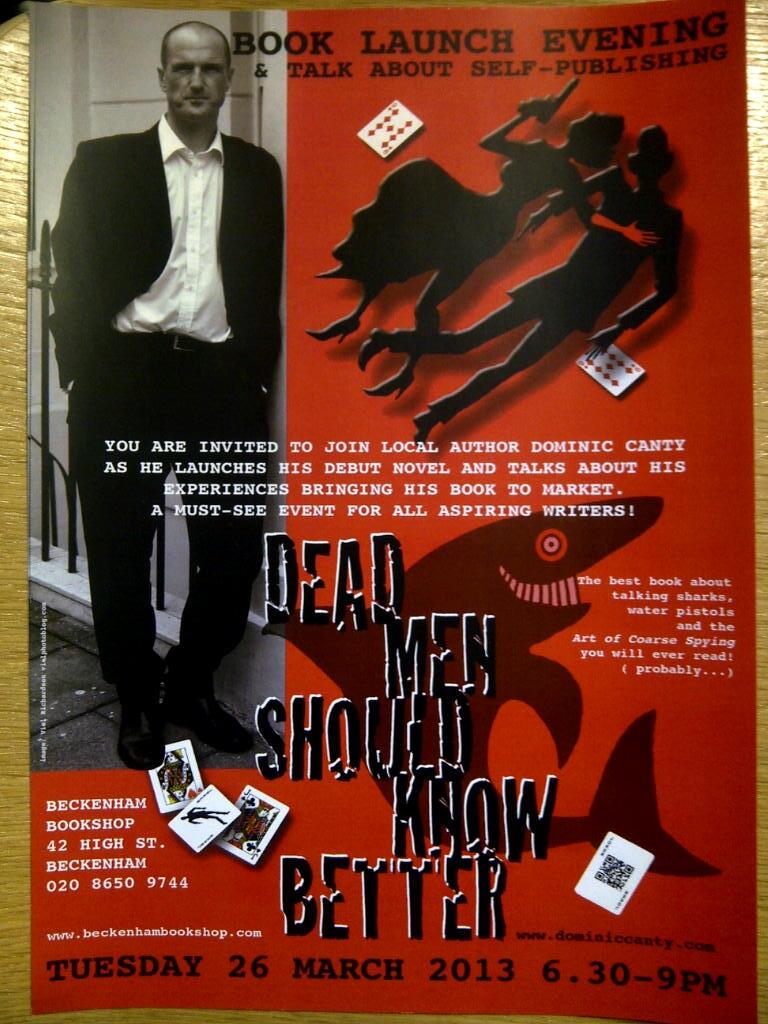
Book Launch, "Dead Men Should Know Better", Dominic Canty

My local bookstore, the wonderful Beckenham Bookshop is one of these places that defies the usual pessimism about high street retail through a combination of fantastic service, being really friendly, and having the creativity to get out there and understand that there's a lot more to selling books than simply having them on the shelf and providing a check-out function.

In this light I'm really pleased to see they're holding a book launch evening for a local author next Tuesday. It's the sort of thing that very much should be encouraged - I'm going to try and be there, and if you're in South London, like books, and think an independent approach to business, publishing, and literature in general should be encouraged, you should try to get along too.

Tuesday, 12 March 2013

"Uncommon Enemy", Alan Judd

As an author, Alan Judd has sporadically accompanied me through a lot of my adult reading life. As a teenager "The Noonday Devil" served to keep my enthusiasm for a university education high, even if the reality was no more like that described by Judd than using Evelyn Waugh as a guide would have been.

At a similar time I encountered Charles Thoroughgood. His appearance in "A Breed of Heroes" provided a counterpoint to the swashbuckling military figures to be found in the thriller authors that had been my standard reading material to that point. Pronouncedly different, "A Breed of Heroes" was not an especially easy read in such a context, but over 20 years later remains memorable.

The Thoroughgood trilogy, written over such a span of time, encompassing the British Army in Northern Ireland, 1980s Cold War espionage, and now, the murky ambiguities of the war on terror, by nature has to be made up individual works that can stand on their own - reliance on distant memories of previous works is dangerous - the second volume, 2001's "Legacy" is after all 10 years ago, and unlike "A Breed of Heroes", was only read by me once. This does make the introduction to "Uncommon Enemy" a slightly difficult process, as memory scrabbles to see if there are threads to be picked up, and intertextuality challenges too - with linkages in particular to Adam Thorpe's "Flight" being felt.

Perseverance rewards; "Uncommon Enemy" is a rich and rewarding work. Book ending Thoroughgood's professional life, the story draws from his university days, the latter part of his spy's life in the 1990s and early 2000s, with the main narrative set in the contemporary period, where now retired, he is recalled to track down an asset, "Gladiator", with whom he shares an deep and extensive personal history. This tale of relationships subsumes what we initially assume to be the core premise - the attempt to use "Gladiator" to track down an Al Qaeda plot in the UK - remember - this is no traditional linear spy thriller.

Judd is easily locatable in the espionage literature universe alongside Charles Cumming and the obvious John Le Carre. Here he is perhaps most reminiscent of Le Carre's 1995 "Our Game", where a similar feel of tiredness and lost certainties can be found. Here too is an ambiguity in ending; there is closure to "Uncommon Enemy", there's a feeling that something akin to 'the right result' has been found, but there are still questions, still a suspicion that the whole story has not been told, and the book is very much better for it.

My old paperback copy of "Legacy" has now come off the bookshelf to be revisited - perhaps the most real endorsement of how enjoyable "Uncommon Enemy" is.


Friday, 5 October 2012

“Mission to Paris”, Alan Furst


I’ve long maintained that Alan First needs to be read in a cold climate. There’s something about him that calls for a stinging rain against the window and an audible wind. Presumably for commercial reasons, his publishers have lately taken to releasing his work in time for summer reading, and that doesn’t work for me. I tried reading “Blood of Victory” in an Umbrian villa by the pool, and it didn’t hand together at all, so since then, no matter when they’re released I wait for nights to grow shorter and the right time to put some Furst into my life.

My reading of “Mission to Paris “ might violate this, because there’s no stinging rain, and the temperature’s anything but cold, but somehow early autumn in the art deco surroundings of Shanghai’s Peace Hotel, with jazz tinkling up through the atrium, wine sipped from elegant glassware, and the knowledge that Noel Coward wrote Private Lives while staying a few doors down the hallway somehow all makes it okay.

Eleven years ago “Night Soldiers” came with me to Moscow. I still miss the sprawling narratives and enormous purview of Furst’s earlier works, but after what’s felt like a little bit of a stutter with “The Foreign Correspondent” and “Spies of the Balkans” Furst seems to be hitting the mark in a way that resonates that little bit more.

Paris has always been a constant in Furst’s work, and here it’s at the heart of the novel, and deep down this works. Ultimately for all it can feel a little repetitive, Paris is a happier hunting ground for Furst.

“Mission to Paris” is all about pre-war cinema – people always liken Furst to watching Casablanca for the first time round, so somehow it makes sense that he’s written something so overtly about cinema – okay, we’ve been here before with the Casson books (who gets a nod here, with the marvellous description of him doing “tasty little films” about gangsters with hearts of gold) but here the film industry is front and centre.

We’ve got a memorable Kristallnacht scene, where Stahl is at the Adlon while Berlin burns. This is redolent of the Iron Exchange chapter in “Dark Star”, ramming home the lingering menace of Nazi Germany as it descended into humanity’s abyss.

Orlova (a marvellous character who, one hopes, will be made more of) reminds of David Downing’s Effi (surname?) – which leads on to the other tribute that can’t surely be accidental – can a character called Stahl who once played “Dr Lawton” really be anything other than a veiled hat tip to John Lawton and his very different historical novels which successfully transcend the pigeon hole of “period crime fiction” or “historical thriller”.

Downside? The denouement seems somehow rushed. Escape is never quite so simple, or is it? There feels as though there should be more of a story here, more opportunity to explore and draw out the story, which otherwise has a languid pace to it? Or is this a reflection of a hunger on the part of the reader to discover the fates of characters they have to care deeply about? Either way the ending doesn’t quite feel as sorted as the rest of the novel –the ambiguity you find in “Dark Voyage” or “The Polish Officer” adds a lot – equally the unravelling at the end of “Dark Star” is ultimately highly satisfying – tying off knots makes for a more satisfying short term reading experience, but lessens the chance of the book remaining with you over a more prolonged period of time.

Ultimately though, it’s an Alan Furst book. Whatever warts it might have it’s an evocation of the world in a dark time that’s completely absorbing and makes your life better for having read it. It’s autumn, the light is growing shorter, there are foghorns on the Huangpu: it’s the ideal time to read it.

Sunday, 5 August 2012

To Love is to Bury

Every once in a while sad days roll around.

In the grander scheme of things, the death of a fish pales, but often it’s in the small mundane elements of life that you get to the real meaning of things, and today, losing Invincible the Fish, or just plain old Fishy, made me cry.

A fish is a much maligned pet. They’re denounced for being short of memory (they don’t seem to be), or for being non interactive (rubbish, he used to throw stones at the wall of his tank to attract our attention, usually related to food). That wasn’t our experience. Having a fish was a lovely happy constant in our lives for almost 12 years.

We buried him between the mock orange and the azalea, under a pottery water jug.

We miss him a lot.


Wednesday, 12 October 2011

"The Crash of '79", Paul Erdman

Sometimes it's all too easy to start a theme going, and financially based thrillers seem as good a one for the moment as any.

I distinctly remember Paul Erdman's "The Crash of '79", and what I always regarded as its successor, "The Panic of '89" being present in vast quantities in the thriller/action section of my local second hand bookstore in Dublin as I grew up during the 1980s. To my teenage eyes they never really appealed, tastes running to more the whiz-bang end of the spectrum then, but as time passes so do tastes change, and when one of my explorations into one of Vermont's many second hand literary Alladin's Caves in Brattleboro last December (Brattleboro Books on Elliot St - which I sincerely hope survived the ravages of Hurrican Irene) yielded up "Crash of '79" for a princely dollar fifty, it seemed churlish not to give it a go.

It seems on the surface ridiculous to mention what initially seems like a true piece of 1970s schlock in the same breath as Harris' "Fear Index", but in actual fact Erdman, a rare beast in being a banker who actually served time in prison for being bad at his job, provides a more relevant tome for today. We have creaking European economies, banks grown fat on deeply flawed asset backed securities, high oil prices with a depressed tanker market, and a cash rich 'new economy' with the potential to re-energise the financial system and shake it out of a prolonged recession. Despite being nearly 40 years old, you can't help thinking the work strikes a chord.

Despite this, it is very dated. The 1970s haven't quite yet had the Mad Men reinvention in popular culture, and as such there's a lot about "The Crash of '79" that makes you wince. The 'hero', Bill Hitchcock, is either an thoroughly unpleasant piece of work, or maybe the 1970s really were like that. Either way, passages such as "in the cab on the long way into town, I decided on my order of priorities: first a drink, then a piece of ass" (p.36 of the 1976 Simon and Schuster edition) jar a little in the present day - and there's a lot of this to get through.

All this said it's strangely readable in a guilty pleasure way, and not just for the economic lessons or the snapshot of 1970s culture, there's a pleasing insight into how most people misread how the 1970s would segue into the 1980s. There's no hint that the Shah, portrayed as an uber alpha male, would flee, dying, into exile in the very year that Erdman saw him making his grab for the Saudi oil fields that would topple the world economy, no suggestion that the 1980s would presage a prolonged era of low oil prices, which would drive a long boom and ultimately play its part in ending the Cold War.

In many levels my teenage self was right to leave "The Crash of '79" on the shelf, it's not great literature, but there's still a suspicion that I might hang on to this, or at the very least use it to torment friends in the oil industry.