Saturday, 9 June 2018

Kitchen Confidential

Anthony Bourdain, 1956-2018

Many words have been written about the passing of Anthony Bourdain, and most of them have been written by those much better placed to comment on his life than me. I didn't work in the restaurant business, didn't eat bun cha with him while President of United States, or have the chance pass the time of day directly with him. All that said, when I spent a lot of time working in the US in the early 21st century he was a Godsend.

Life on the road can be a lonely business. Temporal dislocation, work, and evenings in anonymous hotels; one discovers how walking out the door and finding somewhere else is important. 

In those days the temptation to dick about with your phone was rather less significant, so as a prop or a guard against having to stare into the middle distance one would carry a book. It meant you were never really alone, and it became habitual to spend time in the bars of the wider DC area getting through an awful lot of reading material.

The lovely thing about bars in the US is that if you sit at a table you're more or less signalling you're happy to be left alone, whereas should you choose to sit at the bar you're saying conversation with a random stranger is something you're pretty much open to. In this light the book I would be carrying would often be something commented on, and when it was something reasonably obscure conversation would move swiftly on.

But sometimes reading material would catalyse conversation. My then boss had in passing recommended I had a look at Anthony Bourdain's 'Kitchen Confidential', commenting that his early work was excellent but warning that later material suffered from him starting to believe his own hype; it thus made its way onto my to-be-read pile, into my carry-on, and duly onto a bar in Alexandria, VA.

And what could have been a typical Brit overseas evening, some passing conversations had, some beer drunk, some unhealthy food eaten turned into something else. It transpired everyone had an opinion about 'Kitchen Confidential', everyone had a favourite bit, everyone had a related restaurant story to tell. The book sat on the bar, no reading progress made, as conversation whirled around involving everyone, including the chef who came out to add his 2c worth.

The book's great, it does say a lot about the restaurant business, and makes you a better eater and probably a better cook (he told me to use Global knives, and I still do to this day), but mostly for me it was something that turned what could have been another jet-lagged forgettable evening into something else. Anthony Bourdain in one evening in 2002 or 2003 made me less lonely, one can only wish he'd had as good a prop of an evening in a hotel in Strasbourg recently.

Thank you Anthony, you brought a lot to the world, and you are missed.

Monday, 29 May 2017

To Love is to Bury

They say to love is to bury.

In late 2005 we adopted cats from Battersea. Laphroaig came free, he was ill, had so many issues, and Battersea were just grateful that we were willing to give him somewhere peaceful to eek out his last days.

His first days with us were a challenge. He was shy, he had issues, but he grew on us. He lurked for a long time on the middle landing, and I’d sit near him as he worked out whether this was a good place for him. It was a slow process, with a very tentative cat, but off the back of this we ended up becoming very good friends.

Battersea told us that Laphroaig would never be a lap cat. I worked out early on that that wasn’t necessarily the case, and anyone who has sat still in our house and experienced the joy of white fur being liberally distributed will know that Laphroaig liked people. I don’t like the thought that Battersea know nothing about cats, but they didn’t know anything about the ‘Phroaig that came to live wth us.

An endlessly intrigued, friendly, and charismatic cat, Laphroiaig won over our hearts immediately, and didn’t have to try all that had to make friends more widely. He took various illness best described as old cat syndrome in his stride, and worked with us to find ways of making us sit up and take notice.

Laphroaig loved so many things. He liked being engaged in whatever you were doing, he liked figuring out what people were eating (and if it was cereal or porridge insisting that he has some too) and most of all he loved being outside in his garden, where he could smell things, inspect what was happening, and periodically chase things in a very gentle way.

As a friendly cat he touched many people. Comments such as how people were pleased to have had chance to give him a little fuss, how from a distance they could tell he was loved and how he adored all reinforced how he was part of our family.

Laphroaig died on Friday Morning. My last memory of him was standing on my bed, chatting earnestly to me, wanting to know what I’d been up to. 

I found his remains in his garden. Far beyond the couple of months Battersea thought he would live he was with us for nearly 13 years and he lived into his 20s. He brought a lot of joy to us, he shaped our lives in totally positive ways.

I miss him. I think I’ll miss him every day.

So long Laphroaig, you were the best of me

Saturday, 2 April 2016

The Reality of Navarone

"War in the Islands", Adrian Seligman

I have many reasons to be grateful to the Society for Nautical Research and their journal, the Mariner's Mirror, but perhaps the single standout point that still makes me smile is an article on accounts of sailors during the last days of sailing merchant ships. I read it stood at the bar in Beer Rebellion in Gipsy Hill during the summer of 2014, and exploring its footnotes and references duly acquired many of the works cited; of these Adrian Seligman's The Slope of the Wind stood out as a charismatic tale rich in anecdote and appeal. Let's face it, anyone who responds to the triple whammy of failing exams, being informed by girlfriend that she's marrying someone else, and being threatened by their bank, by running away to sea has got to be a good egg.

Seligman's a fascinating character, as you find through his work. His No Stars to Guide is perhaps the most memorable - an account of breaking a Soviet icebreaker out from the Dardenelles to the Levant that could quite easily have been an Eric Ambler novel.

No Stars to Guide asked questions. What was the wider war career of people like Adrian Seligman? What did the sailor enthusiasts sucked into war in the Mediterranean do? In War in the Islands Seligman starts to address this question. Taking a series of interviews with those who served with such delightfully named outfits as the Levant Schooner Squadron, the Greek Sacred Company, and Aegean Raiding Forces he applies his own story telling ability to the accounts of plain lives in extraordinary times. 

The Aegean campaign in the Second World War has always felt like a backwater. If you've read or seen The Guns of Navarone (and really, who hasn't?) or encountered Captain Corelli's Mandolin you'll be familiar enough with the theatre, the heroism, and the tragedy of what went on here between 1940 and 1945. Throughout all of this you can't help escaping the feeling that despite the exertions of brave men and women in caiques and schooners what was done here did little to alter the ultimate outcome of the wider war in Europe. What happens here feels different to what we know of Stalingrad or Normandy. 

Strangely the remoteness of the conflict humanises it and makes the individual stories told in War in the Islands more powerful and Seligman's gift lies in capturing the emotion and motivation behind the disparate group of people who share their experiences. In this he captures the laconic and modest voices of Paddy Leigh Fermor and Fitzroy Maclean, and provides an account that should appeal to much more than the relatively narrow audience of maritime and military historians.

As a coda, tracking War in the Islands down was an equally rewarding experience. Navigating the shoals of overpriced second hand volumes eventually a nice looking edition was found at a perfectly reasonable price. Duly purchased and package opened to discover the cheerful dedication from the late Adrian Seligman added an appropriately personal and human note to the work. War in the Islands is a deeply personal work, and in encountering a direct link to history like this makes this a more than usually valued possession.


Wednesday, 23 March 2016

The Spies of Croydon

"Icelight", Aly Monroe

When Melita Norwood of Bexleyheath was exposed as a long time Soviet spy in 1999 there was a sense of mild bemusement that a sleepy piece of London south of the river could be linked to the high politics of the the Cold War. Maybe it shouldn't have come as a surprise, Michael Bettaney lived in Coulsdon, and there's no real reason why spies who have little regard for the niceties of sovereignty should eschew territory the other side of the Thames from Whitehall.

Aly Monroe's Icelight holds no truck with London's north-south divide. Travelling down the route from Victoria neighbourhoods of Croydon, Carshalton, and Sanderstead are given star billing. For those familiar with the terrain there's a ring of authenticity, with pubs like the Greyhound, the Swan and Sugarloaf, and the Red Deer all still being identifiable today. This might raise the question of whether Monroe backfilled present day locations to make it feel real, but even if this is the case, it's perfectly credible that this would have been the landscape of 1947.

Making perhaps a link with Michael Bettaney, described variously in this rather good contemporary BBC News account as a 'solitary bachelor with a tendency to drink', known for 'consorting with homosexuals', and guilty of 'fare dodging', Icelight deals with security service persecution of the gay community and low level organised crime throughout, portraying the period in a suitably bleak light, matching the evocation of a cold winter in the face of continued rationing and economic malaise. Paraphrasing Monroe, this England is a fortress island defended against pleasure rather more effectively than it had been against Hitler's bombs.

Over the last few years I've had a few encounters with Aly Monroe's writing. I was initially a bit ambivalent of her first, The Maze of Cadiz, finding the character of Peter Cotton a little hard to grasp. Over the years though Cotton's become more engaging, just as reading about has been. 2009's Washington Shadow brought a vein of darkness, and with Icelight there's a distinct amount of steel throughout the character and the narrative. It compels not just with the strong sense of place that's evoked, but with an ambiguous plotline hinting at the richness buried beneath the strictures of late 1940s Britain.


Tuesday, 15 March 2016

If I Were a Man I'd have a Gun

"Girl Waits With Gun", Amy Stewart

Sometimes the tagline 'based on a true story' is all it takes to conjure memories of Fargo into existence, sometimes however it provides the root of something rather different, if every bit as enjoyable.

It would be all to easy to describe Amy Stewart's retelling of Constance Kopp's battle with Henry Kauffman as gentle 'cozy crime', an impression perhaps conveyed by The Guardian's endorsement of it as a 'marvellous romp', and on some levels that's exactly what it is. The language encourages you to smile throughout - with characters described as having "all the girlish charm of a boulder" and Constance wistfully describing her aspirations as "All I ever wished for was a good clean job in an office and a salary that would allow me to purchase a cabbage if I wanted one, which I didn't think I would."

However the automobile accident that gives rise to the central path of the novel in fact opens up what is a much richer social commentary on the sexual politics of the early 20th century. Constance's sister Norma opines that self propelled vehicles are a path to lawlessness and social chaos, but in actual fact the cracks in social cohesion are already there in the countryside near New York in 1914, and have been for quite some time.

Stewart's use of language, while consistently entertaining is still capable of evoking the deeper, more challenging level of women's place in the society of the day. While never explicitly describing the horror of Erik Larson's The Devil in the White City Stewart's sparse language concerning the seduction technique of Singer sewing machine salesmen and the hinted dread of when a young girl is caught on her own by the river by two men lingers with you, and as a male reader unsettles, in a way it probably should.

The triumph of Girl Waits With Gun is that it communicates a powerful social message about female emancipation, 'fallen women', and access to justice all wrapped in plot that draws you in and never preaches. I don't think romp is the right word for this at all - it's something a lot richer and something I suspect will remain with you a lot longer than you expect.

I thought for a while about what to title this blog post, considering for a while riffing around the original Swedish for The Girl with the Dragon Tattoo, but ultimately I thought that Constance Kopp, were she in the late 20th century would be a Kristen Hersh or Tanya Donnelly figure, so hat tipping to Throwing Muses and Hook in Her Head from 1991's The Real Ramona, I figure she's transcended needing to be a man to have a gun - and ultimately that's somehow shown to be a good thing.


Disclosure: A review copy of Girl Waits with Gun was provided by Scribe Books.


Wednesday, 20 January 2016

Italy Noir

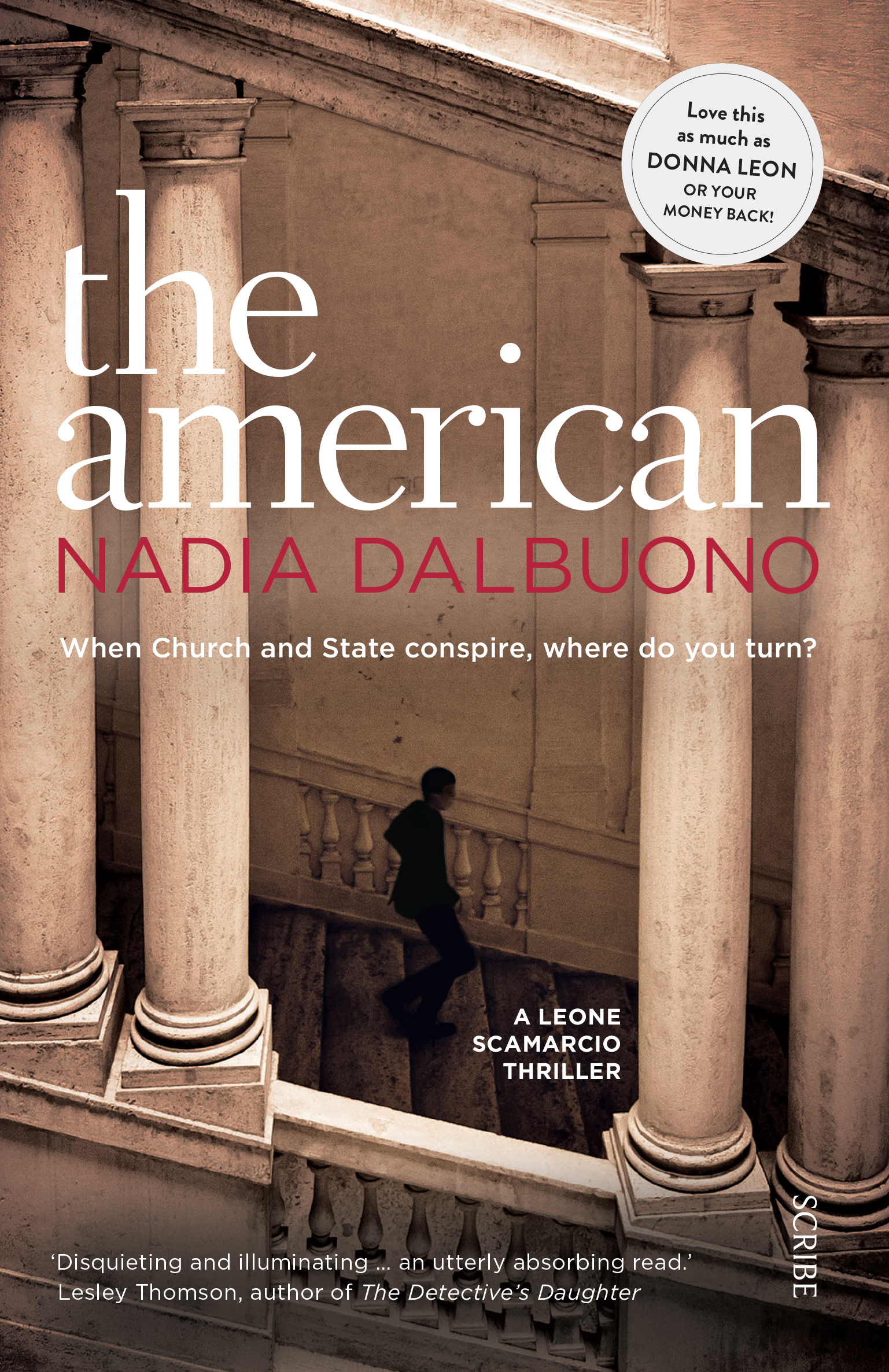
"The American", Nadia Dalbuono

Italy's an odd place.

It's rightly seen as one of the cradles of civilisation, it was a founding member of the European Union, and it's one of the largest economies in the world. 

Despite all this Italy maintains a feel and reputation of somewhere a lot grittier. Perhaps it's the legacy of the extreme left and right wing politics of the 20th century, what we could see as long shadow of 'the mafia', and the overall ramshackle nature of their companies and politics, but Italy feels profoundly different to much of the rest of established Europe.

I'm minded of talking to an Italian friend after rashly purchasing a used (but still over specified) La Pavoni espresso machine a few years ago; he encouraged me to look after it, because along with the Vespa scooter and the original Fiat 500 it summed up what good Italian engineering was, and properly maintained would persist long after Italy had collapsed under its own contradictions.

It's something you can feel on the ground. Working with the technology companies of Bologna and Modena they will sigh if you say need an NDA signed - that will involve getting 'corporate' involved, and thus nothing will happen. Driving through the dramatic hills on the Umbrian-Tuscan border north of Lake Trasimene you periodically catch glimpses on side roads of exotically garbed women on plastic chairs, familiar perhaps outside Naples or Brindisi, but surprising on the edge of Chiantishire. It should be no surprise that Italy provided a fertile ground for Dibdin, Hewson, and Leon, so in this light is there scope for something new?

Nadia Dalbuono's first Leone Scamarcio novel, 2014's The Few, introduced the suitably complicated Leone Scamarcio and insight into seamy underbelly of Italy. Fusing a sprawling political sex scandal into the rich backdrop of Rome, the Mezzogiorno, and Italy's strange continuing predilection for prison islands it delivered an accomplished police procedural that kept attention throughout.

Scamarcio's return deftly avoids the 'difficult second album' challenge, taking promising raw materials found in The Few and refining it into what is a highly polished political crime thriller. Linking the death of Roberto Calvi, the dark days of Italy in the 1970s and 1980s with the confrontation between the Red Brigades and the Italian far right, The American is reminiscent of Frankenheimer's Year of the Gun. It's full of moral ambiguity, shifting loyalties and definitions of truth, and shadowy arbiters of power, and where at times it teeters on the brink of sounding like "all that conspiracy crap you find on the internet" it remains critically just exactly on the right side of the line.

In exploring the complexities of Cold War Italy, with the Red Brigades, Gladio, and the P2 Masonic Lodge Dalbuono posits how the long tail of the 2008 financial crisis and externally imposed austerity could return Italy to the darkness of 1978 or 1982. This is not however what makes The American a great read. What is most satisfying is how Scamarcio emerges as a compromised, ambiguous, flawed yet charismatic character. The interaction between the cop who wants to be clean, the crumbling edifice of the Italian state, organised crime's long memory, and the stirring influence of international intrigue makes for an absorbing read - and the fact that come the ending perhaps more questions than answers are involved leaves you wanting more - and isn't that always a good thing?

Interest piqued? As part of the blog tour accompanying the launch of The American Scribe Books have made an excerpt available, which you can see here. On that note, do please have look at the next stop on the blog tour for The American, over at Tales from the Reading Room.


Disclosure: review copies of The Few and The American were provided by Scribe Books. The used La Pavoni has been properly maintained and is still making fantastic espresso every morning.


Nadia Dalbuono, an excerpt from "The American"

An excerpt from Nadia Dalbuono's The American.

When Scamarcio left the boss’s office, he found the desk sergeant waiting for him in the entrance to the squad room. ‘You’ve got visitors,’ he said.

He was holding open the swing doors for two tall strangers in dark suits. They both wore silver Aviator sunglasses, and their hair was cropped militarily short. Scamarcio’s instinctive assessment was that they were secret service, and probably the Anglo-Saxon variety — English or American.

He walked over to shake their hands, and motioned them to his desk. There was only one spare chair, so he pulled out another from a neighbouring table. The strangers’ arrival was stirring interest among his colleagues, who also knew a spook when they saw one.

He had expected the two men to remove their sunglasses when they sat down, but for some reason they chose to keep them on.

‘English OK?’ said the one on the left, who had blond hair and deeply pitted skin. The accent was American, but Scamarcio couldn’t pin it to a region.

‘Sure,’ he said, wondering if they already knew that he had spent time in the States.

The one on his right crossed his legs, and Scamarcio spotted a gun strapped to an ankle holster. It looked like a Beretta 92 — maybe their standard issue, if they had one.

‘The body you found under the bridge this morning ...’ continued the man on the left.

‘What about it?’

‘He’s one of ours.’

‘A colleague?’

‘No — a suspect.’

‘You’re fast workers. I only sent the photo to our liaison a few minutes ago.’

The stranger didn’t offer an explanation, so Scamarcio asked, ‘What agency are you from? Do you have cards?’

‘We’re US authorities.’

‘That doesn’t tell me much.’

‘That’s all you need to know.’

That settled it. He would give them the bare minimum, nothing more. They were about to piss all over the place — to mark out their territory, as usual.

Pitted skin continued. ‘The guy you pulled out from under that bridge was a fraudster, responsible for manufacturing millions in counterfeit dollars. It was a major op. We’d been on his tail for some time, but it was only recently that he came to realise it. When he sensed that his time was up, he decided to end his life.’

‘Why come all the way to Rome?’

‘He had family here. We think he wanted to say his goodbyes.’

‘This fraudster have a name?’

‘It’s need-to-know.’

‘I need to know.’

‘We don’t share that assessment.’

Scamarcio took a breath, and bit down on a pencil. He tasted lead in his mouth, and wished he could wash it away, but he didn’t want to get up.

‘Listen, Detective, we’re just trying to do you a favour. We know you flying squad guys have your hands full, so we wanted to spare you the legwork and take this one off your slate. We’ll supply you with all the relevant paperwork so you can dot your I’s, cross your Italian T’s. No point breaking a sweat when someone is happy to clean up for you.’

Scamarcio said nothing for a few moments. ‘You know it’s not that simple. This happened on Italian soil, so I’m obliged to investigate.’

‘You’re not listening, Detective,’ said the guy on the right, whose southern lilt was deep and smooth like a Louisiana whisky. Although his eyes weren’t visible, his terracotta tan and perfect white smile seemed to suggest that he was much better looking than his colleague. ‘All we’re saying is that we can help you sew up your case nice and tight in time for you to head out to the coast for the weekend. You guys still go to the beach in October? — seems warm enough to me.’

Scamarcio said nothing. He wasn’t going to be their foreign stooge they could squeeze any which way they wanted. ‘What paperwork do you have?’ he asked eventually.

‘It will be on your desk by close of play tomorrow, and then you can head down to Amalfi for a nice bit of R and R. That’s what I’d do in your position. Really I would.’

The southerner’s words sounded less like a suggestion and more like a threat this time.


Disclosure: review copies of The Few and The American were provided by Scribe Books. See my thoughts on The American here.

Saturday, 16 January 2016

Doing wine the biodynamic way

"Chateau Monty", Monty Waldin

Sometimes a happy accident is just that.

My mother will tell you, and indeed anyone who'll listen, that she struggles with Christmas presents, that she never knows what to get someone, but she does sometimes try, and sometimes she gets it very very right.

I've told my mother about helping a friend with their vine harvest, I've introduced her to more adventurous wine than she's likely to find in M&S, and she's even come to Brockley Market and met the magnificent people at L'Atypique. So she got into her head that wine is something I'm enthusiastic about, and that I'll like the biography of an English bloke trying to make wine in South Western France.

There's no surprise here.

She's Right. I probably will enjoy it.

Initial trepidation that this might be a somewhat sub Year in Provence account of a bumbling rosbif flailing around with the idiosyncrasies of French life are rapidly laid to rest. Chateau Monty is an engaging account of setting up and running a biodynamic vineyard, mixing the homely anecdotes of life in south west France with matter of fact details of what making wine biodynamically involves.

Biodynamics? Well yes, I suppose that does need a bit of explanation. It involves taking principles linking growth with elemental 'forces' connected with the orientation of celestial bodies and energies that can be captured and returned to the soil to help growth. There are times when it comes across as nine parts bollocks. The notion that horn manure is powerful because a cow generates more energy than can be used in its existence, thus it all gets stored in its horn, which can then be transferred to manure stuffed in it and then buried might stretch some people's credibility.


A natural wine, albeit not from Monty Waldin's vineyard.
Leaving aside the skepticism and applying some empirical observation though and there might be something to it. Natural and biodynamic wines can be absolutely fantastic (disclosure, I'm having one now - a marvellous Angevin red from Domaine Mosse) so maybe we should pay attention. There's also something engaging about the way Waldin evangelises about it that makes you want to experiment and see how things might work - after all it doesn't do any harm to plant according to a biodynamic calendar and pay a bit more attention to what sort of chemicals you're sloshing around. If Chateau Monty encourages you to be a bit more creative about what you do with your garden or any piece of land you work, or maybe more realistically drives you to try something slightly more adventurous wine wise than standard supermarket fare then it'll certainly justify the read.

Amusingly I let my vineyard owning friends know that I was reading Chateau Monty. They laughed and said they'd read it too. They'd enjoyed it, found it useful in the context of how they were thinking about wine, and it helped convince them that they could set up a vineyard of their own. They've now got a magnificent vineyard in Kent, and as Woodchurch Wine produce a very good English sparkling wine. For this alone we all should be grateful to Chateau Monty.
Vines inspired by Chateau Monty at Woodchurch Wine.

My response to Chateau Monty hasn't been quite as extreme. I've not decided to jack it all in and start a vineyard, but I have thought about burying a cow horn filled with manure on the allotment and seeing what happens. 

What harm could come from that?

Thursday, 31 December 2015

The Last Spike

"Rails across Canada: A Pictorial Journey from Coast to Coast", David Cable


Despite sharing a telephone dialing code with its more populous neighbour to the south, one area where Canada can hold its head up with a certain level of distinctive identity is in its transcontinental railroad. Just as impressive an achievement as the American drive from sea to shining sea, the twin railroads of the Canadian National and Canadian Pacific span the continental lands mass covering over 30,000 route miles of track.

Culturally there's something very resonant about Canada's railways - perhaps it's because in the great north there's more isolation and the railroad provides one of the tenuous filaments connecting elements of civilisation in the opens wastes together. From the iconic image of Donald Alexander Smith hammering home 'the last spike' at Craigellachie in 1885, through E J Pratt's epic similarly titled narrative poem, to the Cowboy Junkies and their spectacularly melancholy ninth track from 1992's "Black Eyed Man". 

Those looking for a documentary history of the birth of Canada's railways, or indeed an insight into the nature of today's rail system, will not find this in Cable's "Rails across Canada", for this they would be better to start elsewhere, perhaps with Berton's two volumes on the system's origins ("The National Dream" and "The Last Spike"), but as context there is some real value to be had here. In just over 200 pages of photography taken over the course of several journeys across Canada Cable documents the reality of Canadian railways, showing the scale of engineering, the topography dealt with, and the reality that much as in the United States railways in this part of North America are enjoying a renaissance - just one that is comparatively invisible as it is one executed with passengers.

It's a book of few words, but still one that rewards leafing through, discovering Cable's engagement with Canadian railroads and getting a feel for trains draw such a vast country together. It's enough to inspire you at some stage to devote the time to riding the three day journey across the continent, but equally makes you think about the run of the mill elements that through freight stitch the continent together. Can one still dream of hitching a ride on the longest train you ever saw? 


Disclosure: a review copy of Rails across Canada was provided by Pen and Sword Books.

Thursday, 10 December 2015

Strange Things Happen at Sea

"Death of a Supertanker", Anthony Trew


For all the efforts of the UK Hydrographic Office and its international peers, the oceans are still uncharted spaces. The rules of normality become suspended and distorted; what is transgressive ashore becomes accepted when out of sight of land. History is littered with such incidents, running through Tudor Piracy, the Russians firing on the Gamecock Fleet in 1905, and countless Cold War encounters. Much of the traditional narrative on this circulates on the high politics of state, but scratch beneath the surface and there is a strand of stories equally rich and somehow more accessible when you look to merchant shipping. As the likes of Rose George point out, the loss of a commercial airliner will be guaranteed to seize the headlines, the disappearance of a merchant ship, unless it comes to grief in sight of land, will often go unreported and uncommented.

Anthony Trew (1906-1996), novelist and former South African Naval Officer, first came to me in the 1980s with The Antonov Project, a classic Cold War conspiracy pot boiler which sadly has not aged quite as well as might have been hoped. By contrast Death of a Supertanker resonates of a maritime world more recently exposed to us by the aforementioned Rose George and Horatio Clare in Deep Sea and Foreign Going and Down to the Sea in Ships. Death of a Supertanker brings us directly into a world described in Noel Moster's Supership, and exposes the level to which ships cease to become the emotional engagements that they were in the classic era described by Alan Villiers and Adrian Selgimann, and become financial instruments, there to serve base levels of profit and loss, and where consigning a ship to layup is nothing out of the ordinary.  

Very much of its time, with a layer of casual sexism, and a reflection of the geopolitical world of the late 1970s Death of a Supertanker is distinctly a period piece, but usefully represents a period where shipping eras overlapped. Simultaneously this was a period when crews could still repair to a bar before dinner but there was the looming prospect of 36 hours loading in the Gulf before a turnaround and another 6 weeks voyage back to Rotterdam. The halcyon days of the supertankers, perhaps best typified by the French Shell vessels Batillus or Bellamya are evoked here, but so too is the long tanker slump, and the prospect of layup and redundancy, ships riding forlorn in Scottish lochs and Norwegian fjords.

There's a certain poignancy to this too. Many seafarers dream of managing to make the leap back ashore. As Death of a Supertanker closes one of the officer's secures what to him is a plum job - a loading master in Abadan, Iran. With the benefit of hindsight that the passage of time grants us one can't help wondering if that was the smartest move for him...

At its heart Death of a Supertanker is about maritime economics and the shady criminality that can exist at its boundaries. Decisions taken in small anonymous Swiss headquarters impact on the lives of the ordinary sailors aboard the Ocean Mammoth, and while it may frustrate the reader that at this level there are many hanging threads regarding whether or not the fraud leading to the loss of the supertanker pays off or indeed really how it all took place, in many ways this reflects the shadowy nature of the industry, and contributes to a feeling of realism.

Would all this appeal to someone not au fait with how shipping works? The truth is I suspect it might not. Death of a Supertanker is an ambiguous novel and there's a lack of certainty to it throughout, indeed I challenge anyone to be able to say conclusively really what the narrative chain of events described should be. Don't come to it looking for a parcelled up self contained novel - for this maybe Justin Scott's The Shipkiller might be a better bet, but instead use it as an insight into seafaring life in the 1970s, and one which still resonates.

Sunday, 22 November 2015

Four Kinds of Fish

"Day of Atonement", Jay Rayner

There are times when you end up with a novel that confounds expectations. Tempted by a free promotion on it for Yom Kippur, Jay Rayner's Day of Atonement has been sitting on my phone for a while, and when, stuck for something to read on the tube, it was opened, I wasn't entirely sure what to expect.

The last cookery novel I can recall reading (and I'm sure there's been something since) was going through Anthony Bourdain's Bone in the Throat and Gone Bamboo, which managed to be simultaneously entertaining and depressingly dark, so in terms of expectation management Rayner's Day of Atonement has a bit of baggage.

Starting with an elderly ex con on the contemporary Kent coast there's an initial feeling that we might be in Bourdain territory, but that's soon stripped away and we've got an engaging wide ranging rites of passage cultural narrative of London Jewish entrepreneurs through the 1970s, 80s, and 90s. There's a rich sense of place and culture with the distinctive argot of London's Jewish community richly captured combining veracity and an ability to make you smile.

Deep down Day of Atonement isn't really a crime novel, but it's not one where the expected deeply bad things happen. Somehow while there are where you suspect it might be about to turn all a little bit Goodfellas it doesn't. People don't end up necessarily in a shallow grave, and a level of cocaine dependency in the 1970s shouldn't really come as a huge surprise to anyone.

So Day of Atonement was free, so I can't even ask a question of whether even as a discount purchase, was it worth it? But there is a more sophisticated question revolving around whether it rewarded my time and here happily things can be a lot more conclusive: of course it was. Mal and Solly become characters whose stories compel as they move from adolescence to old age, and while it is at heart a morality play, there is a sense of predominantly reasonable wholesome fun (even including Judy the Blow Job Queen) that suffuses the novel.

And yes, it does make clear that the epitome of a good and lavish party is making sure that you don't just have three, but four fishes served. This is probably a life lesson for all of us, gentile or otherwise.

Jay Rayner makes it clear that this is a pre 9/11 novel, a product thus of the very short 21st century where there was a window to see the world through something of a different lens, which gives Day of Atonement it's particular flavour. Try it, I think it's one you might relish, a little like chicken soup.

Saturday, 14 November 2015

Got wood?


"Norwegian Wood: Chopping, Stacking, and Drying Wood the Scandinavian Way", Lars Mytting


Autumn took a while to get going this year. Barely a week ago we were talking about how unseasonably mild it was. That said there have been a few times when November dampness creeps into the bones, and there's nothing quite like a wood fire to sort that out.

Of course now we're properly into blustery autumn, and I'm eyeing up my woodpile, wondering how far through the winter it'll get me, and very grateful for the wood stove in the sitting room (a Charnwood C4 for those interested in such details).

Into this environment comes Norwegian Wood. Not a track by the Beatles, nor a Haruki Murakami novel, but instead a beautifully produced tome on, you guessed it, Norwegian wood. As a country Norway does winter rather more profoundly than the UK - that's geography for you I guess - so it's maybe understandable that their approach to chopping and burning wood is a little more thoughtful. Not for them the indifferent net of soggy logs procured from the petrol station - in Scandinavia it's a process that involves taking a long view, something to go with aquavit and lutefisk to help you through the long dark winter.

This is something that suffuses Norwegian Wood. It's not the sort of work that you can read linearly, instead it rewards dipping into, grasping an element of wood lore that you can apply to your own wood piles and fires, and through this gain an insight to the accompanying cultural context.

Looking at this way Norwegian Wood is a genuinely useful book. To take one example, people have long told me that contrary to popular wisdom of starting with paper, layering kindling on top, and then some small logs, really you should set a fire using a top down approach. Nothing about this seemed to make sense - heat rises right? So surely starting from the top is counter intuitive and flying in the face of reason? 

Norwegian Wood in a matter of fact way explains things. Put a bed of logs on the bottom of your stove, then build paper and kindling on top, this will generate enough heat to help the bigger logs to start to smoulder, and their gasses, rising up, will then combust as they meet the flames from the kindling - simples. It means the process of lighting the fire is less a case of earnestly monitoring it, adding carefully selected pieces of wood, and more a matter of lighting it and letting it run. It's a small thing, but makes a difference.

That's Norwegian Wood in a nutshell. It's a combination of small things that can make your experience with a log fire inherently more enjoyable. It's probably not something to have as your train book, nor necessarily one for bedtime, but there's an argument to be made that having it around where you can pick it up as you go about your day will improve your life.


Disclosure: a review copy of this book was supplied by Maclehose Pres.

Sunday, 13 September 2015

Larsson exhumed

"The Girl in the Spider's Web", David Lagercrantz

There's a theory out there that says you should never go back, and trying to find something that all evidence suggests is gone is always going to be a fool's errand. Most of the time I apply this sort of thinking to revisiting authors from my formative years, but the same point could be made about publishers going back to deceased authors and having a bash at resurrecting them. I can see why they do it, I can see why people are keen on reading them, and I'm also aware it often ends being a little unsatisfactory. Even when it's a talented author revising a mostly finished manuscript there's something lacking in the resulting book.

So how do I feel about David Lagercrantz picking up Stieg Larsson's mantle? I loved the original trilogy, warts and all, and there was a certain excitement about the arrival of the posthumous fourth. The largely positive reviews in the Guardian and Irish Times helped, and realistically, this was always going to be a book I was going to buy.

And you know what? It seems genuinely pretty good. Lagercrantz captures Larsson's voice effectively, the universe is familiar, and the familiar characters are there, like long lost old friends coming back, welcoming in you in despite all the years that have passed. There are some other promising points, The Girl in the Spider's Web isn't a sprawling vast tome stretching the bounds of what can be printed, instead it's a slimmer more focused volume, which raises the prospect of a tighter narrative.  

So does it really work?

It's been a train and bedtime companion for the last few days, and happy long morning saw it finished today, and while I want to write that I'm a touch ambivalent about the book I'm conscious this is selling it undeservedly short. There's the familiar Larsson sprawling plotline ranging across media, politics, and Swedish society, there are the linkages to the deep Salander family storyline, and a topical information age conspiracy to deal with. All of this feels like familiar Larsson territory, but here's where somehow the conciseness of The Girl in the Spider's Web ends up falling a little short. 

The novel is relatively short, but attempts the sort of wide ranging plot lines we had in the first three books, and ultimately there's not the real estate there to do them justice. I often think big doorstep volumes, much like the latter Larssons threatened to be, would benefit most from a strenuous edit, but intriguingly this too feels like it should be a fundamentally better sorted book. The end feels syncopated, and while most hanging threads are tied off, there's a level to which you feel that had Larsson had his hands on this they would have been dealt with in a touch more detail.

But let's not carp. The Girl in the Spider's Web is still ultimately a well paced engaging thriller that ticks all the boxes when you're looking a Scandinavian crime thriller. We can't bring Stieg Larsson back, but if you, like me, have a hankering to know how the Millennium sage evolves, seeing subsequent volumes like this will give us something honestly fine to think about.

I'm going to paraphrase the Guardian here, but if you didn't like the previous Larsson books this won't change your mind, but if you did you'll probably enjoy this. It's not high literature, and nor is it quite on the level of first encountering The Girl with the Dragon Tattoo, but it kept me engaged and warranted it's space in my backpack though my daily commute. It's flawed, but I'm pleased it exists, and I'm pretty sure I really want to see the series continue.

Monday, 31 August 2015

Crusaders and Tigersharks

At some point in my impressionable youth I came across Barrett Tillman's On Yankee Station, a simultaneously accessible and authoritative account of US naval aviation during the Vietnam War. Following on from that I read his MiG Master, a study of the Vought F-8 Crusader, an undeservedly forgotten carrier aircraft, and enjoyed it too. I reacquainted myself with both in my 1990s flirtation with academia but otherwise Tillman ended up filed in the recesses of my mind, probably resurfaceable with a bit of context, but otherwise one for the past.

Sparked a little bit by Singer and Cole's Ghost Fleet, I've nosed around such things as Command: Modern air and Naval Operations, musing that perhaps as a non existent summer segues into autumn maybe some time spent in front of a PC recreating sundry old Harpoon like scenarios might be mildly diverting. Connected with that a dig through their archive surfaced a mention of a Barrett Tillman work of fiction, Warriors

Long out of print, Warriors is still relatively easy to track down for not very much, and it's worth a look. Techno thrillers suffered with the end of the Cold War, and the story arc of Warriors was rapidly overtaken in period by the Iraqi invasion of Kuwait and Desert Storm ushering in the short 21st Century, but the passage of time serves to unearth some of the inherent value to narratives like this. 

Positing a scenario whereby in 1990 Saudi Arabia takes an unorthodox approach creating a parallel air force trained by Western pilots and equipped with the in real life stillborn Northrop F-20 Tigershark and becomes enmeshed in a sprawling recapitulation of the Yom Kippur war Warriors is unusual (very much so for its time) in taking an ambivalent view towards the role of Israel in the Middle East. It's a stance which did not make the novel popular in some quarters at its time of release, but viewed from a perspective 25 years after its publication you can see its point.

Warriors is capable of surprising; where initially it feels like a typical late Cold War military thriller with female characters spatchcocked in as an afterthought, the plot is more well rounded and nuanced than first impression suggest. It's unflinching in its approach to mortality, and much in the vein of Bob Forrest-Webb's Chieftains is not a novel which rewards those who become attached to core figures.

The description of an evolving Middle East and a pan-Arab consensus against Israel rings hollow in an era of Islam's great war of religion and the rise of Islamic State, but the notion of a fragile Saudi monarchy, an interventionist Iran moving beyond the shadow of Khomeini, and a Russia increasingly enmeshed in shaping the region, does indicate that maybe there are aspects we can still learn from, despite the manifest changes the world has seen.

Do we now read 1980s works of this manner in the same way we read pre WW1 war scare fiction? I don't think we do - and if we're being realistic in the same way as the literature of the early 20th century had its ups and downs there's a lot of fairly forgettable material that rode in on the wake of Clancy and his peers. Warriors is not high literature, but when dealing what Tillman knows best it's well written, thought provoking, and keeps you interested throughout.

Worth the investment, and more than that, worth reminding me that Barrett Tillman has written some fine books about aviation.


Thursday, 13 August 2015

The Iconic James Bond

It's a Thursday night, I've come home interested in something burbling in the background, and lo and behold in the outer regions of things satellite there's a Bond film to be found. It's For Your Eyes Only, it took me a while to figure out the name, and I figured that it's not quite a proper Bond film.

James Bond's interesting. I grew up somewhere in the 1970s or 80s (boundaries are vague) and so the Roger Moore era of high kitsch was introduced to me as somehow serious spy fiction. The formative me viewed Moonraker dispassionately, thinking that chemical weapon labs in Venice, transhipment hubs in Rio, and hidden launch platforms in the Amazon were perfectly feasible (and who says they're not?). That small me had no problem when a couple of years later I read the original Fleming and discovered that he didn't have hijacked space shuttles, cable cars, or space marines in the book at all, and really it was much more about the south coast of England and the mundanity of the nascent British space programme

It's a theme the lovely Riddle of the Sands Adventure Club guys explored with Pink Gin and the Man with the Golden Gun a while back, but it's worth disconnecting Fleming's books from the film cannon. The films are escapism, and they reflect the mores of their time; this means they sometimes date a little, showing how society has accepted and sometime celebrated less savoury approaches towards women and displayed unfortunate ethnographic stereotypes. So, when this evening I described "For Your Eyes Only" as somehow not resonating as Bond film what was I thinking?

Vague relative @SeafrontPages suggested it was something to do with the uncertainty of the Thatcher era and a Sheena Easton soundtrack. He's probably got a point.

Colleague @unfortunatalie asked if it was because there wasn't quite enough misogyny in it? She may also have a point.

The truth is probably somewhere else though. 

Bonds should have an iconic location?
FYEO has the whole Greek monastery scene

Bonds should have a massive plot?
No, when they captured the Ambler vibe in Casino Royale (Craig) they worked impeccably

Bonds should be more misogynistic?
Skyfall is maybe the most challenging here in terms of exploitation, FYEO is way more accommodating

So why not remember For Your Eye's Only? Maybe because inherently it's just an okay film. It's not outright bad like the later Dalton or Brosnan works, yet not as good as high points of On Her Majesty's Secret Service, From Russia With Love, or The Spy Who Loved Me, and as such we forget about it. 

Maybe it's time to go back and read some Fleming and see if there's something to be found.


Monday, 3 August 2015

Neuromancer meets Red Storm Rising

In the summer of 1987 my teenage mind was captivated by a weighty tome lent to me by an American friend. The wide-ranging narrative and a whiff of authenticity that somehow overmatched everything else in the techno-thriller cannon. I was ahead of the game, I read Red Storm Rising pleasingly before it got its release in Europe, and when it broke on European shores it became a phenomenon that even my parents managed to pick up, prompting a somewhat curious “are they talking about that book you read on the television now?”.

Red Storm Rising probably wasn’t the first of its type, General Sir John Hackett certainly got there first with his Third World War, but it undeniably spawned a genre. Along with Clancy, the likes of Larry Bond, and Hank Brown mined a rich seam like a gift that kept on giving until the end of the Cold War cut them off at the knees.

The techno-thriller went through a long fallow patch. The 1990s weren’t kind to them and even the long wars in Iraq and Afghanistan failed to spark a credible narrative that recaptured the majesty of Clancy in his pomp.

As a reader it was fine, we found other things to read. Charles Cumming captured the Eric Ambler quiet school of espionage fiction, we ploughed back into history with John Biggins, and when feeling virtuous we would read something a little more like (whisper it) respectable literature, with Alan Hollinghurst, John Irving, and a newly grown up William Gibson.

Remember that last name, because the arrival of Singer and Cole's Ghost Fleet has made most people refer back to Clancy and Red Storm Rising, but as I progressed into it I found myself remembering another novel I read in the mid 1980s rather more than I expected to. Ghost Fleet may well be a Red Storm Rising for the 21st Century, but if so it’s every bit as much an homage to Gibson’s Neuromancer too - and in a nice touch it’s this which gets the namecheck from Singer and Cole in the running text a bit more than the Clancy link that most reviewers (and yes, my hand is up here too) initially introduce things with.

Linking with early Gibson introduces what one of the key subthemes of the novel - Dave Eggers caused some controversy in 2014 with The Circle, and while I read and enjoyed it, I could see why it simultaneously annoyed those in the technology community and may have been a little inaccessible to those outside it. Ghost Fleet works very well as a cautionary tale about society's reliance on devices to tell us things. This is powerfully linked as the novel reaches a climax, as a US Navy officer peers at a data screen rather than a horizon and reflects that "[t]he anxiousness he felt at that one missing piece of data flow was a reminder of how quickly people took for granted the sea of information they floated in. He only hoped that being thrown back into the dark would be even more disorienting for the Directorate generals and admirals who had enjoyed a war of such data dominance so far."

Leaving the roots aside, what’s Ghost Fleet like as a read? Gratifyingly it’s good, and part of me wants to say it’s very good. Just like Clancy (and indeed Gibson) it’s absorbingly pacy, with a series of vignettes telling enough of a story and creatively using negative space to create the vision that what you read is part of a far larger and more sprawling narrative which, critically, yields an interest in knowing more about what’s left unsaid.

There's an authenticity to the Singer and Cole's universe. Revolving around a Mahanite geopolitical view references to how we arrive at the setting from a contemporary point of departure all feel perfectly credible, with notions such as the Second Timor War, the Dharan dirty bomb, and the New York Quake all feel real, and like the unsaid elements of the conflict in Ghost Fleet, become part of a broader story that you want to know more about.  

The style of writing can raise a smile, insights into the fate of Richard Branson, the ultimate expression of Tour de France doping, and victory drives involving children surrendering tablets to be harvested for microchips all make Ghost Fleet a pleasant as well as interesting read.

Is it this century's Red Storm Rising? In truth I'm not sure, but then again I'm also the thick end of 30 years older than I was when I read Clancy's book, so maybe it's about perspective. While lapping up Ghost Fleet there was a part of me that whispered it wasn't quite as wide ranging and magisterial as Red Storm Rising, but equally saying so felt like needlessly carping, because remember, I was having fun reading Ghost Fleet. Either way, Ghost Fleet is a rattling good read, and sticking with the 21st century, remember, you still can't get an eBook of Red Storm Rising.

Disclaimers and disclosure are good things to includes in anything published. Here's a personal bit of disclosure: my PhD looked at the USN of the 1970s and 1980s in some detail, and as such the personality of Chief of Naval Operations Elmo Zumwalt featured strongly and positively. In an era when the notion of heroism is brought into question by Donald Trump, I'm delighted that Ghost Fleet salutes a great surface ship sailor in Elmo Zumwalt.

You can get your copy of Ghost Fleet from Canelo here.

Disclosure: an advance copy of Ghost Fleet was provided by Canelo Books.